A Lifetime of Training: How Smart Programs Evolve Over Time
Learn how training should evolve across a lifetime to maintain optimal body composition, strength, and longevity—and why stacking random workout programs often fails.
By
March 10, 2026

Most people approach exercise with short-term thinking.
They pick a workout program, follow it for a few weeks or months, then jump to something new. Sometimes they add another program on top of the first one—mixing a running plan with a strength program, adding a bootcamp class, or layering in extra conditioning.
While this approach feels productive, it often leads to frustration, fatigue, and stalled progress.
The reality is that effective training doesn’t happen through random programs.
It happens through a long-term progression that evolves as your body adapts over years and decades.
That is exactly what the following model illustrates.
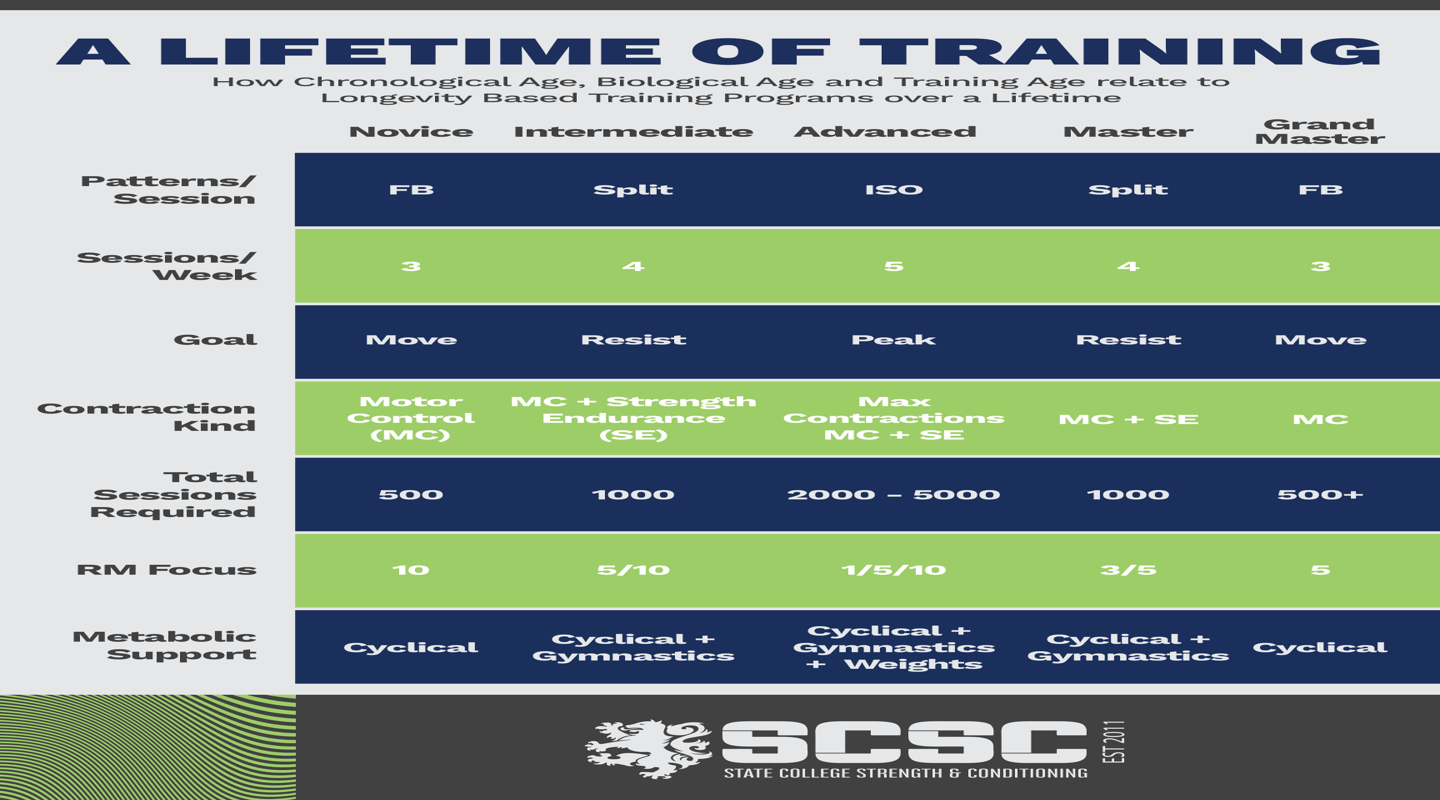
The A Lifetime of Training poster shows how chronological age, biological age, and training age interact to guide the structure of a training program across an entire lifetime.
One of the most important ideas in the poster is the distinction between chronological age and training age.
Chronological age is simply how old you are.
Training age reflects how many years you have trained consistently and intentionally.
A 50-year-old who has never exercised has a novice training age.
A 35-year-old who has trained consistently for 15 years may have an advanced training age.
Because of this, the right training program is not determined by your birth year alone. It is determined by:
This is why two people the same age may require completely different training programs.
The poster outlines five broad stages of training development:
Each stage has a different structure for:
These changes allow training to remain effective without overloading the body or sacrificing long-term health.
In the novice stage, the program structure looks like this:
Session Pattern: Full Body (FB)
Sessions per Week: 3
Goal: Move
Primary Contraction Type: Motor Control (MC)
Repetition Focus: ~10RM
Metabolic Support: Cyclical work
At this stage, the most important objective is learning to move well.
Beginners are not simply building strength. They are developing the neurological ability to coordinate movement patterns such as:
This phase builds motor control, which allows muscles and joints to work together safely and efficiently.
Training three days per week using full-body sessions provides enough repetition to learn movement patterns without overwhelming recovery capacity.
The model estimates that it may take around 500 training sessions to fully develop this foundation.
For someone training three days per week, that may represent several years of consistent work.
Once the foundational movement skills are established, training shifts toward building strength and durability.
The intermediate stage is structured like this:
Session Pattern: Split training
Sessions per Week: 4
Goal: Resist
Contraction Focus: Motor Control + Strength Endurance
Repetition Focus: 5RM and 10RM
Metabolic Support: Cyclical + Gymnastics
Split training allows greater training volume because different muscle groups can recover while others are trained.
The focus shifts from simply learning movements to resisting external loads and developing strength endurance.
Strength endurance allows the body to produce force repeatedly under fatigue.
This stage may involve around 1,000 training sessions before reaching the next level of development.
Advanced athletes train more frequently and at higher intensities.
The structure changes again:
Session Pattern: Isolation emphasis
Sessions per Week: 5
Goal: Peak
Contraction Focus: Max Contractions
Repetition Focus: 1RM / 5RM / 10RM
Metabolic Support: Cyclical + Gymnastics + Weights
At this stage the athlete has accumulated 2,000–5,000 lifetime training sessions.
The body now has the movement skill, strength base, and connective tissue resilience necessary to handle more demanding workloads.
Programs in this stage may emphasize:
However, reaching this level requires many years of consistent training.
As biological aging begins to affect recovery capacity, training goals shift again.
The master stage looks like this:
Session Pattern: Split
Sessions per Week: 4
Goal: Resist decline
Contraction Focus: Motor Control + Strength Endurance
Metabolic Support: Cyclical + Gymnastics
Instead of chasing peak performance, the goal becomes maintaining strength, mobility, and metabolic health.
This stage helps preserve muscle mass and functional movement, which are two of the most important predictors of long-term health.
In later decades of life, training simplifies again.
Session Pattern: Full Body
Sessions per Week: 3
Goal: Move
Contraction Focus: Motor Control
Metabolic Support: Cyclical work
The focus returns to movement quality and maintaining physical capability.
Training sessions support:
These elements help extend health span, allowing people to remain active and independent for as long as possible.
Many people unknowingly disrupt this progression by stacking unrelated training programs together.
For example, someone might combine:
Each program may be well designed on its own.
But when they are layered together without coordination, they create conflicting demands on the body.
This often leads to:
Instead of improving body composition, the body remains in a constant state of stress.
Effective training requires integration, not accumulation.
The ultimate goal of this lifetime training model is not simply athletic performance.
It is to develop and maintain biologically optimal body composition.
This means maintaining:
When these elements are developed together, the body becomes more capable of maintaining health across decades.
Muscle mass supports metabolism.
Movement quality protects joints.
Aerobic capacity supports cardiovascular health.
Together they create a body that is not only stronger but also more resilient over time.
Fitness is often marketed as a short-term transformation.
But the reality is that health and performance are built through years of consistent training.
The most successful individuals are not the ones who follow the most intense program.
They are the ones who follow the right program for their stage of development and progress through those stages intentionally.
When training is structured this way, it becomes possible to maintain strength, movement capacity, and healthy body composition for an entire lifetime.